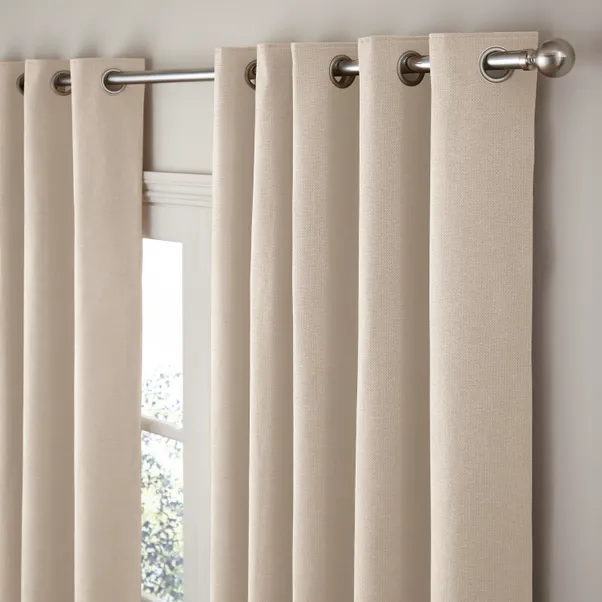
Curtains are fabric panels hung from a pole or track that can be drawn across a window or door and pulled back to the sides when not in use. When they are made to measure, the width, drop, heading and lining are chosen for that one window, rather than adapted from a standard size. That matters most where light control, privacy or draughts are a daily issue, or where the window is wide, tall, angled or fitted with a door. The right curtain does more than cover glass: it softens the room, frames the window, helps manage glare and evening privacy, and, with the right lining, can make a room feel noticeably more settled on a cold evening.
What Are Curtains?
A curtain is a length of fabric, usually made as a pair, that hangs in folds from a heading. The heading is the finished top of the curtain and decides how it gathers, slides and stacks when open. Pencil pleat gives soft, gathered folds and works on a pole or track. Pinch pleat is more tailored, with fixed groups of folds that hold their shape. Eyelet curtains thread directly onto a pole and form broad, even folds. Wave curtains use a specialist track to keep folds evenly spaced, which can suit wide windows and glazed doors.
Curtains may be unlined, lined, blackout lined, thermal lined or interlined. Unlined curtains are lighter and suit sheers and some casual fabrics. A standard lining adds body, protects the face fabric from sunlight and helps the curtain hang more evenly. Blackout lining is designed to stop light passing through the fabric itself, although some light can still enter around the sides, top or through eyelets. Thermal lining adds an extra layer intended to reduce draughts and heat movement at the window. Interlining is a further soft layer placed between the face fabric and the lining, giving a fuller drape and extra insulation. The lining choice often matters more than the pattern on the front.
Curtains can also be layered. A sheer or voile layer can stay closed during the day to soften daylight and screen the view in, while a heavier lined pair closes at night for privacy and darkness. The same approach works with a blind fitted inside the recess and curtains hung outside it: the blind handles daytime light and privacy, while the curtains add warmth and a finished frame.
What Problems Do Curtains Solve?
Curtains are most useful when a window needs covering across its full width, rather than fine adjustment in small steps. They help in bedrooms where street lighting or early summer light makes sleep harder, and in living rooms where evening privacy matters once lamps are on. A lined pair can reduce the cold feel near an older window and cut down glare on a television screen when drawn.
They also solve a visual problem. A bare window, a narrow frame or a long expanse of glass can make a room feel unfinished. Floor-length curtains can make a ceiling feel taller and give a large window a clear focal point. For bay windows, a made-to-measure track that follows the angles can turn an awkward shape into a single, coherent dressing, rather than three separate coverings that never quite meet.
Key Benefits of Curtains
Full coverage. When closed, a lined pair covers the whole window area, giving strong evening privacy and a high level of darkness for bedrooms.
Flexible light options. Sheers filter daylight, lined curtains block most light, and layering gives a daytime and a night-time setting at the same window.
Warmth and draught reduction. Heavier fabrics and thermal or interlined curtains add a layer between the room and the glass, helping a room feel less draughty. The effect depends on fabric, lining, fit and how closely the curtain sits to the wall and floor.
Sound softening. Thick fabric can soften echo in rooms with hard floors and high ceilings, although curtains do not soundproof a room.
Wide fabric choice and room softness. Cotton, linen blends, polyester, velvet and wool each drape differently. Fabric adds texture that hard blinds and shutters do not, which suits living rooms and bedrooms in particular.
Adaptability. Curtains can be changed more easily than a fitted shutter if tastes or room use change, and a sheer layer can be added or removed as needs change.
Where Curtains Work Best
Living room
The living room is often the strongest case. A full-length pair frames the main window, adds colour and texture, and gives evening privacy without making the room feel closed during the day. A voile layer behind them keeps daytime light while screening the view from outside.
Bedroom
Bedrooms benefit most from blackout lining, especially for street-facing rooms, rooms with security lighting nearby, or for people who sleep during the day. A track or pole fitted above and wider than the frame helps reduce light at the edges, and floor-length curtains reduce gaps at the bottom. For children's rooms, choose cordless operation where available and keep any cords, tiebacks or loops out of reach.
Bay windows
Bay windows need careful hardware. A bent track or a pole made for bays follows the angles so curtains draw smoothly and meet in the middle. Eyelet curtains are generally less suitable for bays, because the rings cannot easily pass support brackets at the angles. Check window handles, vents and any window seat before choosing length: sill-length curtains may suit a bay with a seat, while floor-length curtains suit a bay without one.
Patio and French doors
Long curtains can work well if there is enough wall space for the curtains to stack back clear of the doorway. A wave heading or a smooth track helps with daily use. Measure carefully around handles, and make sure stacked curtains do not block the door swing or sit in a walkway. Where wall space is tight, vertical blinds are often the more practical option for a sliding door.
Kitchen, bathroom and conservatory — with care
Curtains are not the first choice for every kitchen or bathroom. Steam, cooking grease, splashes and condensation can stain fabric and, in a damp room, encourage mildew if curtains are not cleaned and dried properly. Short, washable curtains or a voile at a kitchen window can work, but trailing fabric near a hob should be avoided. In bathrooms, moisture-resistant blinds are usually more practical. In a conservatory, strong sun can fade colours over time, so lining that protects the face fabric is worth considering.
Privacy and Light Control
Privacy from curtains depends on fabric, lining and time of day. A lined curtain, when closed, gives full privacy at night. A voile or sheer gives daytime screening: from outside, the room is softened and detail is hard to make out, while daylight still comes through. That effect reverses at night. When indoor lights are on and it is dark outside, a sheer alone will show shapes and movement inside, so a lined curtain or blind is needed for evening privacy.
Light control with curtains is less graduated than with a blind. A curtain is mainly open, partly drawn or closed. That is fine for bedrooms and living rooms, where full darkness or full daylight are the usual needs, but less useful where you want to tilt light away from a screen while keeping the room bright. Layering solves much of this: keep the sheer closed for filtered light and privacy during the day, and close the lined pair at night.
Thermal Performance and Energy Efficiency
Curtains can help a room feel warmer, but the benefit depends on the whole set-up. A heavy fabric with thermal lining or interlining, hung close to the wall, wider than the frame and long enough to sit near the floor, creates a still layer of air between the curtain and the glass. That layer slows heat movement and reduces the draught felt near the window. Lighter, unlined curtains give far less benefit, and a short curtain that ends above a radiator will not perform in the same way as a full-length pair.
Fit matters as much as fabric. Gaps at the sides, a pole fitted too low, or curtains that stop well short of the floor all let air move around the edges. Curtains hung over a radiator need thought too: a full-length pair in front of a radiator can trap warm air behind the fabric rather than letting it into the room. In that case, a sill-length curtain, a blind inside the recess, or dress curtains that stay open may be more sensible. Curtains should not be sold on bill savings alone; they support comfort and reduce draughts, but they do not replace glazing, insulation or heating controls.
Materials, Fabrics, Colours and Finishes
Cotton and cotton blends are versatile, hold colour well and suit both casual and tailored headings. Linen and linen blends have a relaxed texture and drape, but can crease and may need lining to hang evenly. Polyester fabrics are often easier to care for and more resistant to fading, which suits busy rooms. Velvet gives depth, weight and a formal feel, and works well with pinch pleat headings and interlining. Wool and wool blends feel warm and structured, and suit rooms where insulation and a fuller drape matter.
Colour choice should start with light and room size. Pale neutrals keep a small room feeling open. Mid-tones add warmth without darkening the room too much. Dark or patterned fabrics can anchor a large living room, but will make a small, north-facing room feel smaller if used in a heavy weight. Pattern scale matters: a large print needs enough fabric to show the repeat, while a small print can look busy across a wide bay. Always check a fabric sample in the room, in both daylight and evening light, before ordering.
Curtain headings
Heading choice affects look, movement and stack-back — the amount of wall space taken up when curtains are open. Pencil pleat is adaptable and familiar. Pinch pleat is tailored and holds its shape, but needs accurate measurement because the pleats are fixed. Eyelet gives broad, modern folds and slides well on a pole, but needs a pole rather than a track and can let light through the eyelet holes. Wave gives regular, even folds and stacks neatly, but needs a compatible track.
Poles, tracks and finials
A pole is visible and can be part of the look, with finials in wood, metal or painted finishes. A track is more discreet and often better for bays, heavy curtains and rooms where the curtain needs to draw smoothly every day. For heavy, lined or interlined curtains, check that the pole or track and its brackets are suitable for the weight.
Made-to-Measure vs Ready-Made Curtains
Ready-made curtains suit a standard window, a short-term need or a room where exact darkness and draught control matter less. They come in fixed widths and drops, so hemming or a compromise on length is common, and a bay or tall window rarely fits well from a standard range.
Made-to-measure curtains are cut and finished for the measured width and drop, with the heading, lining and hardware chosen together. That helps with bays, tall windows, wide patio doors and rooms where blackout needs to work properly, because edge gaps and length can be planned rather than accepted. It also allows fabric quantity, known as fullness, to be set for the heading, so folds look even rather than stretched thin or overly bulky.
Things to Consider Before Choosing
Start with the room's main job: sleep, privacy, glare, draughts or appearance. Then check the practical details. Is there enough wall space either side for curtains to stack back without covering too much glass? Does a radiator sit below the window? Do handles, vents or a window seat affect length? Will the curtains be drawn daily, or mainly left open as a frame? Daily-use curtains need a smooth track or pole and a heading that glides well.
Think about cleaning before you buy. Heavier, lined and interlined curtains are more work to take down and clean than a light voile. If the room is dusty, near a road, or used by pets, a washable fabric or a fabric that can be vacuumed regularly may be more realistic than a delicate silk. Check the care label for the exact fabric and lining you choose.
Also consider light at the edges. No curtain blocks every trace of light on its own. A pole or track fitted higher and wider than the frame, a blackout lining, and, where needed, a blackout blind behind the curtains will give the darkest result. If total darkness matters for sleep, discuss that aim at the measuring visit so the fitting route is chosen for it, not added as an afterthought.
Potential Disadvantages — and When Another Blind May Be Better
Curtains take up more space than blinds, both when closed and when stacked open. In a small room, or on a narrow window with little wall space, they can make the room feel smaller and block light even when open. They are also less precise for light control: you cannot tilt a curtain to soften glare while keeping the view, as you can with a Venetian blind.
Cleaning is heavier work. Large curtains need taking down, and some fabrics need dry cleaning or professional care. Sunlight can fade face fabrics over time, especially on south-facing windows, and damp rooms can cause mildew if curtains stay damp. Heavy curtains need strong hardware, and a poor track on a bay will jam and spoil daily use.
A blind may be better where space is tight, where the window sits above a sink or worktop, where moisture is a regular issue, or where precise daytime light control matters most. Roller blinds suit kitchens and bathrooms, Venetian blinds suit offices and rooms with glare, and vertical blinds suit wide sliding doors.
Curtains Compared With Similar Alternatives
| Option | Best for | Light and privacy | Care and space |
|---|---|---|---|
| Curtains | Living rooms, bedrooms, bays, large windows | Strong darkness and evening privacy when lined and closed; sheers give daytime filtering only | More fabric to clean; need stack-back space when open |
| Roller blinds | Kitchens, bathrooms, offices, smaller windows | Good privacy; blackout versions darken well; less graduated control | Wipe-clean fabrics; neat, space-saving fit |
| Roman blinds | Bedrooms, living rooms, smaller bays | Soft fabric look with better edge control than a curtain in a tight recess | Fabric care similar to curtains, but less bulk |
| Venetian blinds | Offices, kitchens, rooms with glare | Most precise light control by tilting slats; privacy without full darkness | Easy to dust; slats need regular cleaning |
| Vertical blinds | Patio and sliding doors, wide windows | Slide fully clear of the door; good daytime control | Practical for doors; less softness than curtains |
| Curtains over a blind | Living rooms and bedrooms where both softness and control matter | Best of both: blind for day, curtains for night and warmth | Most hardware and fabric; needs space and a professional measure |
Measuring and Professional Fitting
A good result starts with measuring the window, the wall space and the obstructions around it, not just the glass. The fitting route — pole or track, inside or outside the recess, height and width beyond the frame — decides how much light leaks, how smoothly curtains draw, and how much glass is covered when they are open. For bays, each angle and section needs measuring, and the track needs to be bent or joined to follow those angles.
Dream Blinds UK offers a home consultation and measurement service, so fabric, lining, heading and hardware can be chosen in the room, with samples seen in natural light. The usual stages are consultation and fabric choice, measurement, production to those measurements, and fitting with the curtains hung and dressed so folds fall evenly. If you are measuring yourself for a quotation, note handle positions, radiator depth, window seats and any coving or picture rails that could affect pole or track height, and do not guess tolerances for a bay or a heavy lined pair.
Cleaning and Maintenance
Vacuum lightly with an upholstery attachment, working down the folds, and shake out dust where practical. Deal with marks promptly following the care label for that fabric, and avoid soaking a lined or interlined curtain unless the label allows it. Sheers and many polyester curtains can be washed gently, often at a low temperature, and hung back slightly damp so their weight pulls out creases. Velvet, silk, wool and heavily lined curtains usually need dry cleaning or professional care, and should be kept dry and well ventilated.
Take curtains down carefully, keeping pairs together and noting which side each belongs to. After washing or cleaning, rehang while the fabric is still slightly damp where the label allows, and dress the folds by hand so they fall evenly. In damp rooms, allow air to circulate behind curtains and avoid leaving them closed against a cold, wet window for long periods.
Who Should Choose Curtains?
Curtains are a good choice if you want a softer, more finished look in a living room or bedroom; need strong evening privacy and darkness, especially with blackout lining; have a wide, tall or bay window that ready-made sizes do not fit well; want to reduce draughts and the cold feel near an older window; like the texture and colour range of fabric, and are happy with the cleaning involved; or want to layer a sheer for daytime light with a lined pair for night. If space is very tight, moisture is constant, or you need precise glare control during the day, a blind — alone or layered behind curtains — may serve you better.
See samples in your own home — book a home consultation.
FAQs
Are curtains or blinds better for a bedroom?
Curtains with blackout lining are often better where full darkness and a softer finish matter, especially in larger bedrooms. Blinds can be better in a small bedroom or where space is tight, because they sit inside the recess and stack neatly. For the darkest result, a blackout blind behind lined curtains works well, as the blind closes edge gaps that curtains alone can leave.
Do blackout curtains block all light?
Blackout lining stops light passing through the fabric itself, but light can still enter around the sides, above the pole or track, below the hem, and through eyelet holes. Fitting the track or pole wider and higher than the frame, choosing floor-length curtains, and adding a blind behind them will reduce those gaps.
Can people see through voile curtains at night?
Voiles give useful daytime screening, but they do not give full privacy at night. When indoor lights are on and it is dark outside, shapes and movement can be seen through a sheer. For evening privacy, close a lined curtain or blind over the voile.
What is the difference between lined, thermal lined and interlined curtains?
A lined curtain has a backing layer that adds body and protects the face fabric. Thermal lining is a specific lining intended to reduce draughts and heat movement at the window. Interlining is an extra soft layer placed between the face fabric and the lining, giving a fuller drape and further insulation.
Are thermal curtains worth it?
Thermal or interlined curtains can make a room feel less draughty and more comfortable, particularly on older or larger windows, when they are well fitted and closed in the evening. The effect depends on fabric, lining, length and how closely they sit to the wall. They support comfort, but they do not replace glazing or insulation, and they should not be chosen on promised bill savings alone.
Are curtains suitable for kitchens and bathrooms?
They can work in a well-ventilated kitchen or bathroom away from splashes, especially as a short, washable curtain or voile. They are less practical where steam, grease or constant moisture are present, and trailing fabric near a hob should be avoided. In most bathrooms and busy kitchens, a moisture-resistant roller or Venetian blind is easier to keep clean.
What curtains work best for bay windows?
A made-to-measure track that follows the bay angles usually works best, with a pair of curtains across the whole bay rather than separate curtains for each section. Pencil, pinch pleat and wave headings suit bays better than eyelet headings, which can catch on brackets at the angles.
Should curtains cover a radiator?
Full-length curtains in front of a radiator can trap warm air behind the fabric, so heat reaches the room less effectively. Options include a sill-length curtain that ends above the radiator, a blind inside the recess, or dress curtains that stay open and do not pull across.
Can you use curtains with blinds?
Yes, and it is a common solution. A blind inside the recess handles daytime privacy and light control, while curtains outside the recess add softness, evening privacy and extra insulation when closed. Check that there is enough depth and wall space for both, and that the curtain track does not block the blind's operation.
How do I clean curtains?
Vacuum regularly with an upholstery attachment and follow the care label for the specific fabric and lining. Many sheers and polyester curtains can be washed gently and rehung slightly damp. Velvet, silk, wool and heavily lined or interlined curtains usually need dry cleaning or professional care.