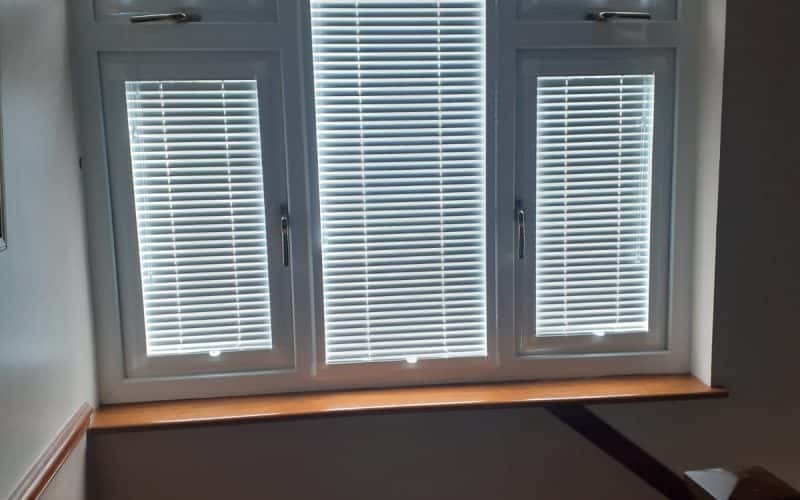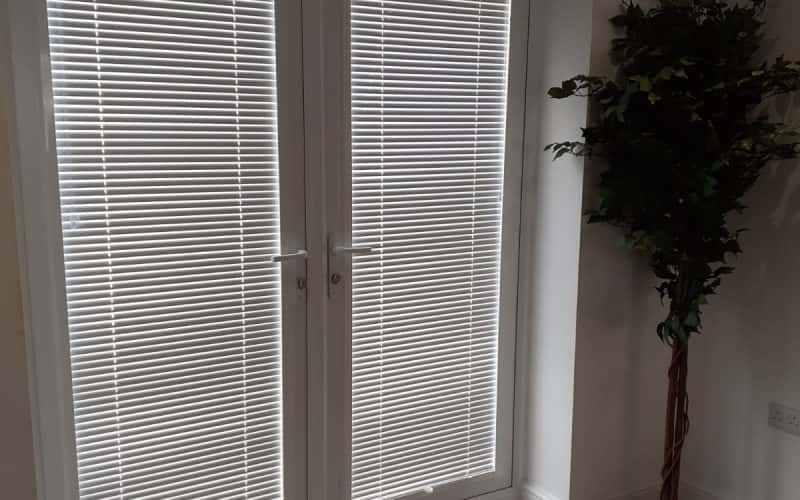
Perfect Fit blinds are made to sit inside the window or door frame, close to the glass, rather than hanging in front of the opening. A slim frame, or in some systems a headrail and side channels, holds a pleated, cellular, Venetian-style or roller blind in place. The whole unit moves with the window or door when it is opened or tilted. That is the main reason people choose them: the blind stays neat, does not swing, and keeps the glazing usable. The fabric itself is only part of the decision. The frame, the bead the brackets sit against, the handle clearance and the way the door folds or slides matter just as much.
What are Perfect Fit blinds?
The usual Perfect Fit system uses small brackets that slide between the glass and the rubber glazing bead of the window. A frame made to the size of that individual pane then clips onto the brackets. The blind sits within that frame. Pleated and cellular versions are often operated by a small handle or tab, moving the fabric up or down, and some can be lowered from the top as well. Venetian-style versions tilt their slats. Roller versions in a Perfect Fit frame give a flat fabric drop within the frame.
This is different from a standard blind, which is usually fixed to the wall or to the top of the window recess and hangs in front of the glass. With Perfect Fit, each pane has its own blind. A French door with two glazed panels therefore needs two blinds, and a bay window needs one for each section. That pane-by-pane approach is central to how the system looks and works, and it also explains why it is not the right answer for every opening.
What problems do Perfect Fit blinds solve?
The most common problem is a blind that gets in the way. A standard blind on a door can swing when the door moves, catch on the handle, or hang into the room and block the walkway. Because a Perfect Fit blind travels with the door, it stays close to the glass and out of the way. The same applies to tilt-and-turn windows, where a loose blind can flap when the window is tilted for ventilation.
The system also helps where drilling is a concern. It is designed to avoid drilling into the frame, which can matter for new windows, rented homes, or anyone who does not want screw holes in a frame they have just paid for. The close fit helps with light control as well. A standard blind can leave a clear gap at the sides, especially on a door. The frame around a Perfect Fit blind reduces that side gap, although it does not remove every source of light, particularly at the top or around a Venetian slat.
Finally, Perfect Fit solves a tidiness problem. On a conservatory or a modern uPVC window with several panes, a single large blind can look heavy and be awkward to adjust. Individual framed blinds give a more ordered appearance and let you cover one pane while leaving another clear.
Key Benefits
Control of the blind itself. It does not swing, it does not need to be tied back, and it can be adjusted pane by pane. On a door, that means you can cover the panel nearest a neighbouring house while leaving the other panel open for light.
Simple operation. Pleated and cellular versions are often cordless in the sense that there is no long hanging loop to manage, which also keeps the front of the window clear. The frame gives the blind a finished edge, so it looks like part of the window rather than an addition. Frame colours are usually chosen to sit close to common window colours, such as white or anthracite, so the frame does not dominate.
Privacy and room darkening. For bedrooms and street-facing rooms, the close fit can improve privacy and room darkening, particularly with a blackout or cellular fabric. It is not a guarantee of total darkness, as explained below, but it is usually closer than a loosely fitted blind of the same fabric.
Where Perfect Fit blinds work best
Living rooms
Perfect Fit works well where the window is used often, for example a living-room window that is opened for air or a glazed door to the garden. The blind stays with the opening, so daily use does not mean constantly repositioning fabric.
Bedrooms
In bedrooms, a blackout pleated or cellular version in a Perfect Fit frame can reduce side light and give good daytime privacy. If complete darkness matters, check the fabric and the fit together, and consider whether a second layer, such as curtains, is needed.
Kitchens and bathrooms
Material choice matters more than the frame here. Aluminium Venetian-style versions and moisture-resistant pleated fabrics are easier to wipe than a soft fabric that will hold steam and cooking marks. In a bathroom, ventilation and the distance from direct water contact should still be checked. A blind that sits very close to glass in a steamy room will need regular wiping to avoid marks building up behind it.
French and patio doors
Hinged French doors are one of the strongest uses. Each door leaf carries its own blind, so the doors can open and close without the blind swinging. Sliding patio doors need more care. The added frame can interfere with the sliding movement or with the way panels overlap, so a vertical blind or a different door treatment is often more practical. Bifold doors also need a clearance check: the frame must not stop panels folding back fully or sitting flush when open.
Tilt-and-turn windows
These are a natural fit, because the blind tilts and turns with the sash. Handle position still matters. A handle that projects into the frame area, or a vent that sits within the pane, can affect which blind depth and frame will work.
Conservatories
Conservatories often have many individual panes, including side windows and doors. Perfect Fit can give a consistent look across those panes and avoid long blinds that are difficult to reach. Roof glazing is different: a Perfect Fit frame for a vertical window does not dress a roof panel, which needs a blind designed for that angle and fixing.
Bay windows
A bay is treated as several separate panes. Each section gets its own frame and blind, which keeps the angles tidy but means several blinds to operate. If you want one blind across the whole bay, this system is not the right choice.
Privacy and light control
During the day, a lowered pleated or cellular blind gives strong privacy while still letting diffused light through, depending on the fabric. A light-filtering fabric keeps the room bright but prevents a clear view in. A blackout fabric gives a much darker room and stronger privacy, at the cost of daylight.
At night, the position reverses. With lights on inside, a light-filtering fabric will show shapes and movement more clearly from outside. A blackout fabric, or a closed Venetian slat, gives much stronger night-time privacy. Venetian versions have a small limitation: there can be a slight gap between the top slat and the headrail, and light can pass between slats if they are not fully closed. For that reason, a Venetian Perfect Fit blind is best described as offering good privacy rather than total blackout. Top-down operation, where available on pleated and cellular versions, is useful for street-facing rooms. You can lower the top of the blind for daylight while keeping the lower part closed for privacy at eye level.
Thermal performance and energy efficiency
A Perfect Fit blind can help with comfort at the window, but it does not turn a window into an insulated wall. The benefit comes from two things working together: the fabric and the close fit. A cellular fabric traps air in its pockets, which slows heat movement more than a single flat fabric. A pleated fabric also creates a layer in front of the glass. The frame reduces air movement around the edges compared with a blind that hangs away from the window.
That help is limited by the window itself. Heat still passes through the glass and the frame, and any gap, handle cut-out or imperfect fit reduces the effect. In summer, a light-coloured or reflective fabric can reduce glare and solar gain, but a blind on the inside of the glass cannot stop all heat entering the room. The honest way to judge Perfect Fit for warmth is as a comfort improvement at the window, not as a promise of lower bills. If warmth is the main goal, the fabric choice and the fit should be discussed together, and the Energy-Saving / Thermal Blinds page gives more detail on cellular construction.
Materials, fabrics, colours and finishes
Perfect Fit is a system, not a single material, so the choice is really a combination:
Pleated fabric: Soft, folded fabric that diffuses light. Available in light-filtering, dimout and blackout options. It folds neatly when raised and suits living rooms, bedrooms and conservatories.
Cellular (honeycomb) fabric: A pleated fabric with air pockets formed into cells. It looks similar to pleated fabric from the front but has a more structured feel and is the usual choice where warmth at the window is a priority.
Venetian-style slats: Usually aluminium, sometimes faux wood. Slats tilt for variable light control and are easier to wipe in kitchens. They give a crisper, more structured look than fabric.
Roller fabric: A flat fabric drop within the frame. It gives a clean, plain appearance when lowered, but does not offer the same top-down adjustment as a pleated blind.
Frame colours are normally kept neutral so the blind reads as part of the window. Fabric colours range from whites and greys to deeper tones, but the range within a Perfect Fit system is narrower than for a standard roller or Roman blind, because the fabric must work within the frame and its operating mechanism. Samples seen against your own glass and daylight are more reliable than a screen image.
Made-to-measure vs ready-made
Perfect Fit is, by its nature, a made-to-measure system. The frame must match the individual pane, including its bead profile and depth. A ready-made blind that is roughly the right size cannot clip securely into a frame it was not made for, and a poor fit can leave the blind loose, uneven or difficult to operate.
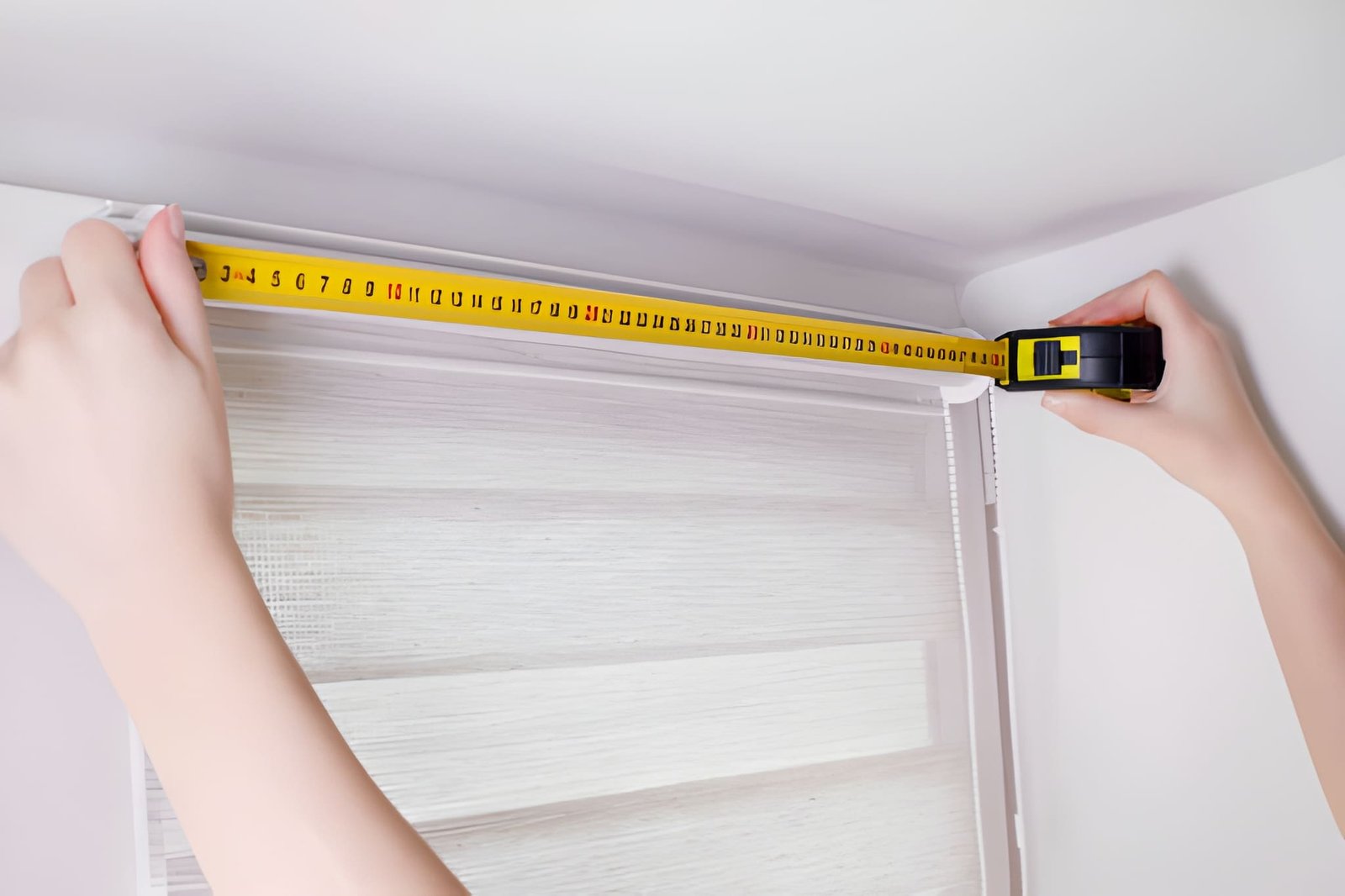
That is why professional measuring matters here more than for some other blinds. The measurer checks the bead type, bead depth, handle clearance, any vents or trickle vents, and whether the window is square. Small differences between panes in the same house are common, especially where windows were replaced at different times. Each pane is measured separately. The trade-off is that you cannot simply buy one blind for a whole window; you buy one per pane, which affects the overall cost of dressing a multi-pane window or door.
Things to consider before choosing Perfect Fit blinds
Check the frame first. Perfect Fit is most commonly associated with uPVC windows and doors with a suitable glazing bead. Timber, aluminium and older frames may not have the bead profile the brackets need, and some tilt-and-turn and sliding systems need a specific check. If your window has a very shallow bead, a flush bead, or glass held by putty or solid beading, the system may not suit it.
Look at handles and opening. Will the frame clear the handle when the window is opened? Will it clear a neighbouring wall when a door swings? On a roller version, the headbox can project and catch a wall on some doors. On a small pane, the frame itself takes up a noticeable part of the glass, so the window can feel smaller when the blind is raised.
Think about how often you clean the glass. Because the blind sits close to the glass, cleaning behind it usually means unclipping the frame. That is straightforward for one window, but it becomes a longer job across a whole conservatory. Also consider condensation. In a room with high humidity, moisture can sit behind a close-fitting blind, so ventilation and regular wiping matter. Finally, think about operation. Several small blinds mean several adjustments. If you want to open a whole bay at once, or you want a single blind for a very wide opening, a standard blind or a vertical blind may be simpler to live with.
Potential disadvantages / when another blind may be better
Perfect Fit is not suitable for every window, and it is better to know that before ordering. It is generally not suited to traditional sliding sash windows, curved or arched glazing, or frames without a compatible bead. Sliding patio doors and some bifold systems can be compromised by the added frame, as noted above.
The visible frame is a matter of taste. Some people like the framed, built-in look; others prefer as much clear glass as possible, especially on small windows where the frame is more noticeable. The frame can also make the blind feel slightly bulkier than a frameless system such as INTU, which uses a headrail and side channels rather than a full frame. Cleaning is another practical limit. The back of the blind and the glass behind it are less accessible than with a blind that hangs away from the window. Dust can gather where the frame meets the glass.
If any of these points apply, consider: a standard roller or Roman blind for a timber window or a deep recess; a vertical blind for a sliding patio door or a very wide opening; a roof-window blind for angled glazing; or a frameless clip-in system where a slimmer profile matters more than a full frame.
Perfect Fit blinds vs similar alternatives
| Feature | Perfect Fit blinds | Standard roller / pleated blind | INTU blinds |
|---|---|---|---|
| Fitting | Frame clips into the glazing bead, designed to avoid drilling into the frame | Usually fixed to wall, recess or frame with screws | Clips into the bead, with a headrail and side channels rather than a full frame |
| Movement | Moves with the window or door | Hangs in front of the opening and can swing on a door | Moves with the window or door |
| Light gaps | Generally smaller at the sides because of the frame | Larger side gaps are common, especially on doors | Small, but the lack of a full frame can leave slightly more edge light |
| Best for | Tilt-and-turn windows, hinged French doors, multi-pane uPVC windows | Deep recesses, timber windows, wide openings, single-blind coverage | Small windows where a slimmer profile is wanted |
| Less suited to | Sliding doors, some bifolds, sash windows, incompatible beads | Doors that are opened constantly, where swinging is a nuisance | Very large panes, where a full frame may feel more robust |
The comparison is not about one system being better in every case. It is about which fitting matches the window you actually have.
Measuring and professional fitting
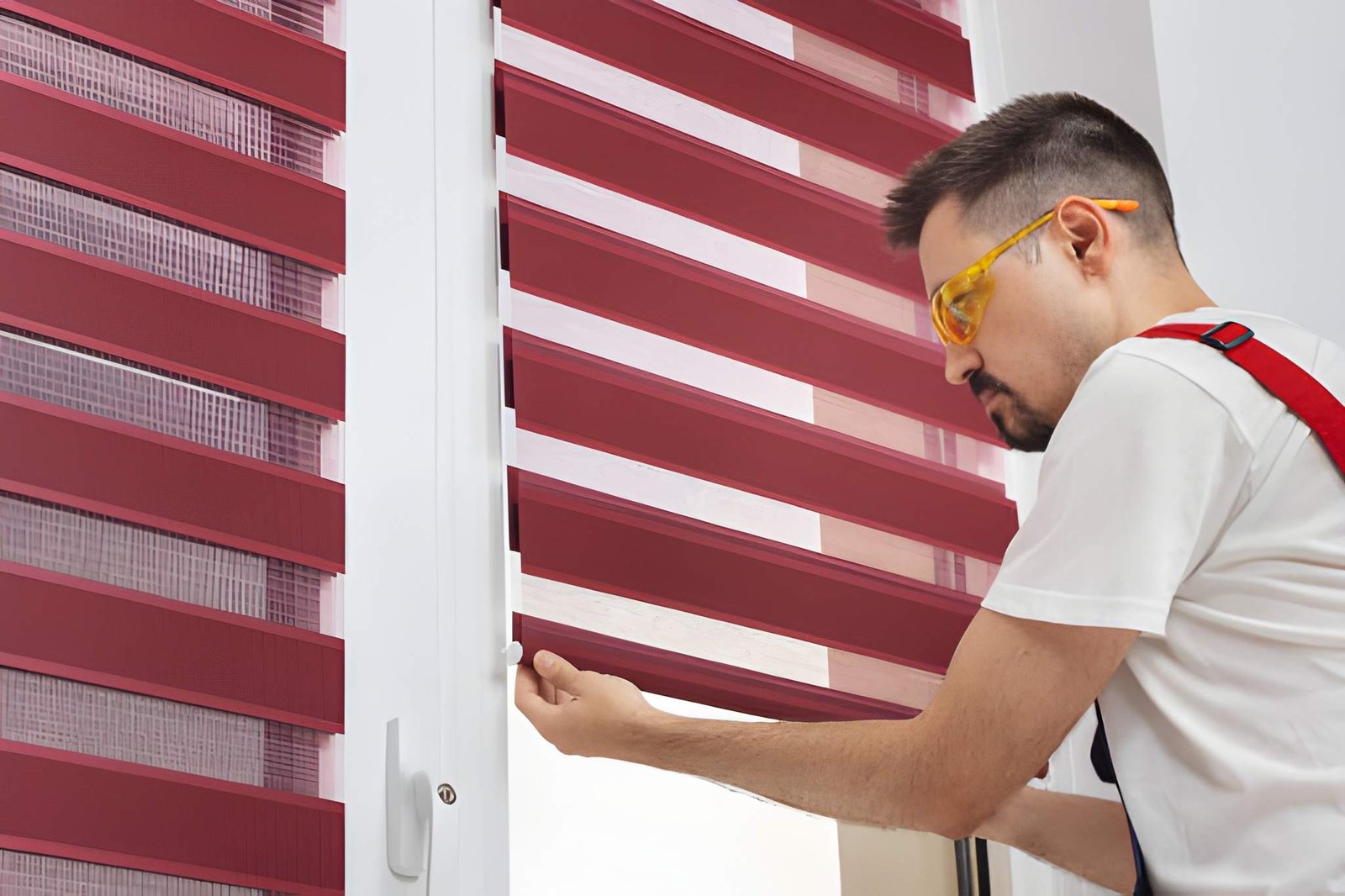
A home consultation for Perfect Fit blinds starts with the windows themselves, not the fabric catalogue. The adviser checks the frame material, bead profile and depth, handle position, vents, and how each window or door opens. Samples are then held against the glass in your own daylight, because a fabric that looks pale in a showroom can look darker against a north-facing window. Each pane is measured individually. The frame and blind are then made to those measurements. On fitting, brackets are placed between the glass and the bead, and the frame clips into place. The fitter checks that the window or door still opens, tilts and closes freely, that handles clear the frame, and that each blind operates smoothly. If a pane is found to be unsuitable during measuring, that should be explained before anything is made, rather than discovered at fitting. For homes in Bradford and elsewhere in West Yorkshire, an in-home visit is particularly useful for Perfect Fit, because bead profiles and handle positions vary even between windows in the same property.
Cleaning and maintenance
Cleaning depends on the material inside the frame. Aluminium Venetian slats can be dusted with a soft cloth or a slat duster and wiped with a lightly damp cloth. Pleated and cellular fabrics should be dusted gently or vacuumed on a low setting with a brush attachment. Avoid soaking fabric blinds, and follow the care guidance for the specific fabric, since harsh cleaners can mark or weaken the material. To clean the glass, the frame usually needs to be unclipped. Keep the brackets and clips free of dust, and check from time to time that the frame still sits evenly. If a blind starts to stick, sag or catch, it is worth having it checked rather than forcing it, especially on a tilt-and-turn window where the mechanism works harder than on a fixed pane. Cordless operation, where fitted, keeps the front of the blind clear, and any cords or chains on other blinds in the home should be kept out of reach of young children and pets.
Who should choose Perfect Fit blinds?
Perfect Fit blinds may suit you if you have uPVC windows or doors with a suitable glazing bead, confirmed at measuring; have tilt-and-turn windows or hinged French doors that are opened often; want a blind that stays close to the glass and does not swing; prefer a tidy, framed look and do not want to drill into the frame; want pane-by-pane control, for example privacy on one panel and light on another; or are happy to unclip frames occasionally to clean the glass behind them. They may not suit you if you have sliding doors, sash windows, incompatible beads, very small panes where the frame would dominate, or a single very wide opening you want to cover with one blind.
See samples in your own home — book a home consultation to check your frames, handles and door movement before choosing a fabric.
FAQs
Are Perfect Fit blinds suitable for all windows?
No. They are most commonly suited to uPVC windows and doors with a suitable glazing bead. Timber, aluminium, sash, curved and some tilt-and-turn or sliding systems need a specific check, and some will not suit the system at all. A professional measurement should confirm bead profile, bead depth, handle clearance and how the window opens before ordering.
Do Perfect Fit blinds need drilling into the frame?
The system is designed to avoid drilling into the frame. Brackets normally slide between the glass and the glazing bead, and the frame clips onto them. That does not mean every window qualifies, and it does not mean the blind can be fitted to any frame. Compatibility still depends on the frame type and bead.
Can Perfect Fit blinds be fitted to patio doors?
It depends on the door type. Hinged French doors are often well suited, because each leaf carries its own blind and the blind moves with the door. Sliding patio doors are different: the added frame can interfere with sliding or with how panels overlap, so a vertical blind is often more practical. Bifold doors need a fold-back clearance check.
Can Perfect Fit blinds be fitted to tilt-and-turn windows?
Yes, in many cases, and this is one of their strongest uses, because the blind moves with the sash when it tilts or turns. Handle position, vent position and bead depth still need checking, and the frame must not stop the window closing or tilting freely.
Are Perfect Fit blinds good for blackout?
They can be closer to blackout than a loosely fitted blind, especially with a blackout pleated or cellular fabric, because the frame reduces side light. They do not guarantee total darkness. Light can still pass around a Venetian slat, at the top of the frame, or through a light-filtering fabric. For complete darkness, discuss fabric and fit together.
Are Perfect Fit blinds good for bedrooms?
They can work well, particularly with a blackout or cellular fabric for privacy and reduced side light. Top-down operation on pleated versions is useful for daylight with privacy. If you are a light sleeper, check the fabric in your own room light and consider whether curtains or a second layer would help.
Are Perfect Fit blinds suitable for kitchens and bathrooms?
The frame system can work in both rooms, but material choice matters. Aluminium Venetian-style blinds and moisture-resistant pleated fabrics are easier to wipe than soft fabrics that hold steam. Ventilation still matters, and the blind should be kept clean and dry where steam or cooking marks build up.
How do you clean Perfect Fit blinds and the glass behind them?
Dust slats with a soft cloth, or vacuum pleated and cellular fabrics gently with a brush attachment. Wipe aluminium slats with a lightly damp cloth. To clean the glass, the frame usually needs to be unclipped, the glass cleaned, and the frame clipped back. Avoid soaking fabric blinds and avoid harsh cleaners unless the fabric guidance allows them.
Are Perfect Fit blinds child-safe?
Many Perfect Fit pleated and cellular versions are operated by a handle or tab rather than a long hanging cord, which keeps the front of the window clearer. Safety still depends on the specific product and operation chosen. Keep any cords or chains on other blinds out of reach, and ask about cordless options during the consultation.
Can Perfect Fit blinds be removed if I move or change windows?
They are designed to be removable by unclipping the frame, which is useful for rented homes or for cleaning. They are made to the size of a specific pane, however, so a blind made for one window will not necessarily fit another window, even in the same house.
Do Perfect Fit blinds make a room warmer?
They can improve comfort at the window, especially with a cellular fabric and a close fit, by slowing heat movement and reducing draughts around the edges. They do not replace window insulation, and the effect depends on the glass, the fabric and the fit. They should not be sold as a way to cut bills by a set amount.
What is the difference between Perfect Fit and INTU blinds?
Both are clip-in systems designed to avoid drilling into the frame. Perfect Fit normally uses a full four-sided frame around the blind, which gives a more structured look and can reduce side light. INTU normally uses a headrail and slim side channels, giving a slimmer profile that some people prefer on small windows. The right choice depends on bead depth, handle clearance and the look you prefer.